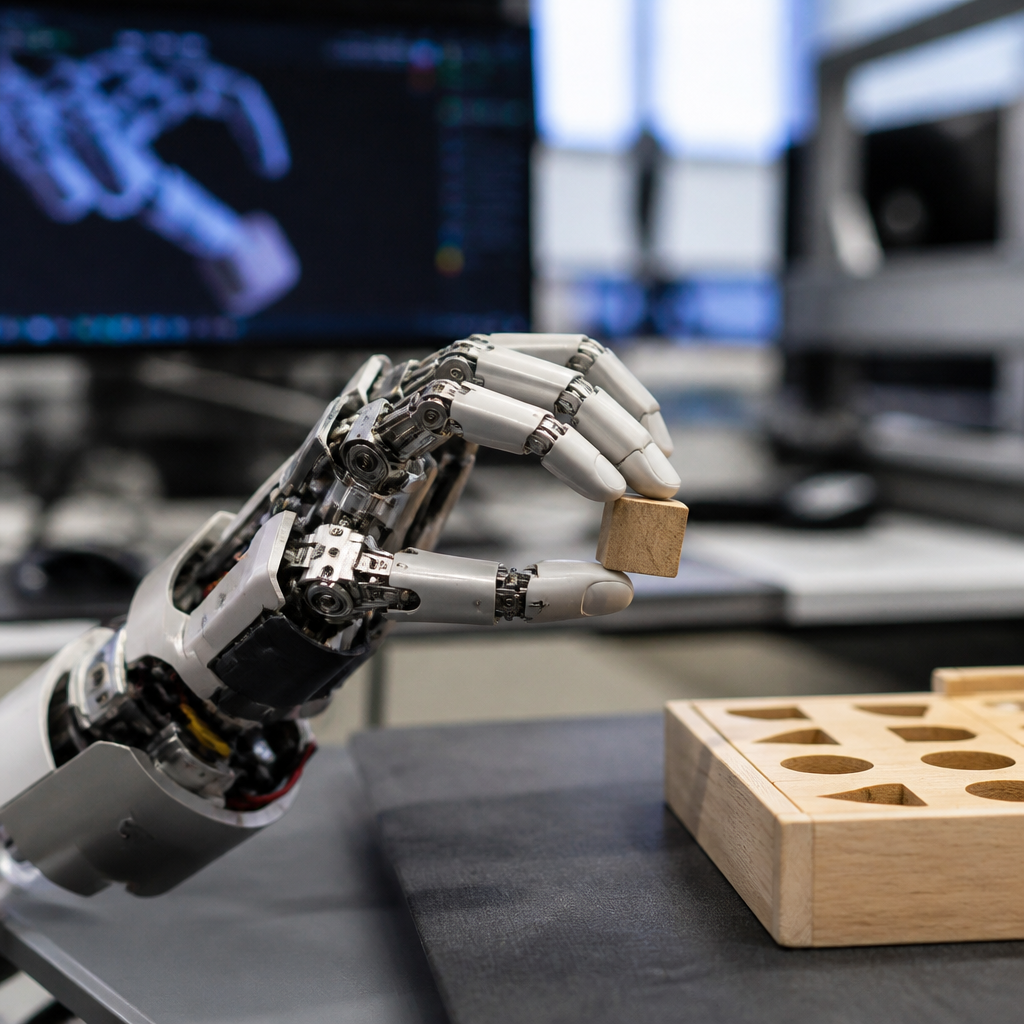
Dexterous robot hands sit at the center of the current physical AI boom because manipulation, not mobility, is the bottleneck between impressive demos and useful machines. In robotics, dexterity means the ability to grasp, regrasp, rotate, insert, fold, sort, and assemble varied objects with speed and reliability. Physical AI refers to software systems that perceive the world through sensors, reason about action, and control hardware in real environments. I have worked with warehouse picking systems and lab grippers, and the pattern is always the same: robots can move through space reasonably well, but handling the messy diversity of real objects remains hard. That is why Silicon Valley startups, foundation model labs, chip companies, and industrial incumbents are racing to build robot hands that can approach human-level manipulation.
This matters far beyond hardware novelty. A capable robot hand expands the total addressable market for robotics into logistics, manufacturing, food handling, retail backrooms, elder care, agriculture, and home assistance. Warehouses still rely on people for exception handling because packaging changes, bags crumple, labels glare, and objects arrive in unstable piles. Factories automate repeatable motions, yet many final assembly steps still need human fingers. In healthcare and domestic settings, safety, compliance, and touch sensitivity are nonnegotiable. A general-purpose manipulator could unlock labor productivity, reduce repetitive strain injuries, and let firms automate tasks that fixed tooling cannot economically solve. For startups in tech innovations and startups, this is the hub topic because advances in sensors, simulation, chips, data pipelines, and multimodal models all converge at the robot hand.
Understanding the race requires three linked questions. What makes dexterous manipulation technically difficult? Which companies and research groups are setting the pace? And what business models can turn promising prototypes into durable companies? The answers span mechanics, machine learning, controls, and operations. A useful robot hand needs high degrees of freedom, low-latency control, calibrated tactile feedback, robust perception, and training data that covers edge cases. It also needs maintainability, cost discipline, and safety certification. The firms most likely to win will not simply copy the human hand; they will balance complexity with reliability and train systems on the task distributions customers actually pay for.
Why manipulation is robotics’ hardest problem
Manipulation is difficult because the robot must close a perception-action loop around objects whose properties are only partially known. A box can be rigid or crushed, a tomato can bruise, a cable can snag, and a garment can fold unpredictably. In practice, every grasp is a physics experiment. Vision estimates pose and shape, but occlusion hides contact points. Force-torque sensors help, yet contact dynamics change millisecond by millisecond. Tactile sensors improve confidence, but they introduce data bandwidth, calibration drift, and durability challenges. Even a simple pick-and-place task becomes complex when the item is reflective, transparent, deformable, or packed tightly against others.
Human hands solve these problems through anatomy and lifelong learning. The hand has more than twenty mechanical degrees of freedom, rich tactile sensing, and compliant tissue that absorbs error. Humans also use priors from experience: when a mug slips, the grip adjusts before the object falls. Robotic systems need substitutes for all of that. Engineers combine parallel-jaw grippers, tendon-driven fingers, underactuated hands, soft grippers, depth cameras, tactile arrays, and reinforcement learning. No single method dominates because task requirements vary sharply. Bin picking apparel differs from inserting connectors on an electronics line, and both differ from unloading groceries in a home.
The technologies defining the Silicon Valley race
The race is being shaped by four technology stacks: hand design, sensing, control, and data. Hand design choices determine what the rest of the stack must compensate for. A simple suction cup can outperform an anthropomorphic hand in e-commerce fulfillment if most stock keeping units have flat surfaces. By contrast, multi-finger hands matter when reorientation, in-hand manipulation, or tool use is required. Shadow Robot, Allegro Hand, and Schunk hands have long served research, while newer commercial efforts focus on durability, lower bill of materials, and integration with mobile manipulators and humanoids.
Sensing is moving from camera-only perception toward multimodal feedback. GelSight-style tactile sensing, fingertip force sensors, wrist force-torque sensors, and event cameras are increasingly relevant. In several pilots I have seen, adding tactile confirmation cut failed picks more than adding another vision model because the system finally knew whether it had contact. The tradeoff is cost and fragility. Sensors embedded in fingertips must survive repeated impacts, dust, oil, and cleaning cycles. The winning systems will use tactile data selectively, not extravagantly, and fuse it with vision through tightly synchronized control loops.
Control has also changed. Classical robotics relied on analytic grasp planning, impedance control, model predictive control, and carefully structured state machines. Those tools still matter; they are essential for safety and precision. What is new is the use of imitation learning and reinforcement learning to handle contact-rich tasks where exact modeling breaks down. NVIDIA Isaac, MuJoCo, and Isaac Lab are common training environments, while domain randomization and system identification help bridge simulation to reality. Startups that master sim-to-real transfer gain a decisive advantage because collecting physical robot data is slow and expensive.
| Layer | What it does | Current leaders and examples | Main constraint |
|---|---|---|---|
| Hand hardware | Creates grasps, compliance, and finger motion | Shadow Robot, Allegro, Sanctuary, Tesla Optimus prototypes | Durability versus dexterity |
| Sensing | Measures vision, touch, force, and slip | GelSight, Robotiq FT sensors, Intel RealSense, event cameras | Calibration and cost |
| Control | Turns perception into stable motion | Impedance control, MPC, learned policies, grasp planners | Latency and reliability |
| Data and training | Builds policies from demonstration and simulation | NVIDIA Isaac, MuJoCo, teleoperation datasets, synthetic scenes | Sim-to-real gap |
Who is competing, and what strategies are emerging
Silicon Valley’s competition includes pure-play dexterous hand startups, humanoid robotics companies, infrastructure providers, and large AI labs extending into embodiment. Figure, 1X, Apptronik, and Tesla pursue broader humanoid platforms where hands are crucial but not the only challenge. Covariant built strong credibility in AI for picking and induction by focusing on warehouse manipulation before its acquisition by Amazon. Dexterity, despite the name, has emphasized industrial manipulation systems using supervised autonomy and teleoperation for trucks, parcel handling, and warehouses. Sanctuary AI has promoted general-purpose robots with dexterous hands as a route to task flexibility.
Another strategic camp is enabling infrastructure. NVIDIA supplies compute, simulation, and software frameworks that shape how many robotics teams train and deploy policies. Google DeepMind, through work on robotic transformers and vision-language-action models, influences the software layer even when it does not ship the hand itself. OpenAI’s earlier Dactyl work on solving a Rubik’s Cube with a robotic hand helped legitimize reinforcement learning for in-hand manipulation, even though it was not a product. The practical lesson from that line of research was not that every robot should solve cubes; it was that large-scale randomized training can produce robust finger coordination under uncertainty.
The strongest go-to-market strategies start narrowly. Instead of promising a household robot that does everything, successful teams pick workflows with clear labor pain and measurable return on investment. Parcel singulation, kitting, tote depalletizing, grocery order assembly, and machine tending are attractive because throughput, error rate, and uptime are quantifiable. Customers care less about human-like motion than about picks per hour, mean time between failure, and total cost of ownership. In procurement meetings, elegant finger design rarely closes the sale; serviceability, spare parts, and integration with warehouse management systems do.
Why data, teleoperation, and simulation are now decisive
Dexterous robot hands improve only as fast as teams can generate useful data. Unlike web text, manipulation data is expensive because every label involves a robot, a scene, and physical consequences. That reality explains the rise of teleoperation. Operators using VR controllers, exoskeleton gloves, or master arms can demonstrate grasps and recover from failure, producing trajectories that bootstrap policies. In my experience, teleoperation is not merely a stopgap; it is a production tool for edge cases and a rich source of examples for imitation learning. It also gives startups a path to revenue before full autonomy.
Simulation fills the scale gap. Thousands of virtual episodes can explore object poses, friction coefficients, lighting conditions, and grasp strategies faster than a physical fleet can. However, synthetic success can be misleading. Contact modeling in simulation remains imperfect, especially with deformable objects, thin plastic, or articulated packaging. Teams that do this well use closed-loop iteration: train in simulation, test on hardware, collect failure cases, update system identification parameters, and retrain. Foundation models may accelerate policy generalization, but they do not remove the need for careful robotics engineering. Real-world manipulation remains unforgiving of latency, poor calibration, and weak recovery behaviors.
Commercial realities, safety, and what comes next
The business case for dexterous robot hands depends on matching capability to environment. In structured factories, specialized end effectors will remain cheaper and more reliable for many stations. A custom gripper designed for one automotive component can beat a general hand on cycle time and maintenance. In semi-structured settings, however, the economics are shifting. Labor shortages, rising wages, and pressure for next-day fulfillment are making flexible manipulation more valuable. Amazon, Ocado, and major third-party logistics providers have all pushed the market toward systems that can handle SKU diversity rather than a single packaged product.
Safety and standards will shape adoption as much as model quality. Collaborative applications must account for ISO 10218 and ISO/TS 15066 guidance around industrial robot safety and human-robot interaction. Hands add pinch points, higher contact complexity, and new failure modes during handovers. Reliability targets are also severe. A pilot that works at 85 percent success may look impressive on video, yet it fails economically if a site needs 99.5 percent task completion with bounded recovery time. This is why the best teams obsess over exception handling, remote support tooling, and preventive maintenance, not just benchmark videos.
Looking ahead, the likely winners in physical AI and robotics will combine competent hardware, multimodal sensing, disciplined control, and a data engine tied to real customer workflows. Some applications will favor anthropomorphic hands, especially where tools and human-designed environments dominate. Others will use simpler hybrid grippers with a few dexterous features added where they matter most. For founders, operators, and investors following tech innovations and startups, the key insight is clear: manipulation is becoming the defining systems challenge of modern robotics. Track the teams proving reliable task completion in production, study how they gather data, and follow this physical AI and robotics hub as the market moves from striking demos to durable deployment.
Frequently Asked Questions
Why are dexterous robot hands considered such a critical challenge in physical AI?
Dexterous robot hands matter because manipulation is where robotics stops being a controlled demo and starts becoming useful in the real world. A robot can navigate a hallway, map a room, or avoid obstacles, but if it cannot reliably pick up a bag, rotate a connector, place a part into a tight fixture, or handle soft and irregular items without dropping them, its usefulness remains limited. In practice, the hard part is not just reaching an object. The hard part is making stable contact, adapting grip force, responding to slip, and changing strategy when the first attempt fails. That is why manipulation is widely seen as the bottleneck between impressive mobility systems and truly general-purpose machines.
Dexterity in robotics includes grasping, regrasping, rotating, inserting, folding, sorting, and assembling across a wide range of objects, surfaces, shapes, and failure modes. Humans do these tasks with astonishing ease because our hands combine many joints, rich tactile sensing, fast reflexes, and years of learned motor experience. Reproducing even a small portion of that capability in machines is extremely difficult. It requires advances in hardware, sensors, control systems, simulation, data collection, and machine learning. In the current physical AI boom, dexterous hands are attracting intense attention because they sit at the intersection of all of those fields. If companies can solve manipulation well enough, robots become dramatically more valuable in warehouses, manufacturing, labs, logistics, retail operations, and eventually homes.
What does “dexterity” actually mean for a robot hand in real-world applications?
For a robot hand, dexterity is not just about having many fingers or looking human-like. It is the practical ability to interact with varied objects quickly, accurately, and repeatedly under real operating conditions. A dexterous system should be able to pick up objects of different sizes and materials, adjust grip based on weight and friction, recover from small positioning errors, and complete tasks even when the environment is imperfect. In real deployments, that means handling everything from rigid boxes and metal parts to plastic bags, cables, garments, produce, and delicate consumer goods.
True dexterity also includes in-hand manipulation, where the robot changes the position or orientation of an object after grasping it. That might involve rotating a package to read a label, aligning a part before insertion, shifting a tool in the fingers, or regrasping a component to prepare for assembly. These are deceptively hard actions because they depend on precise timing, force control, and sensory feedback. A system that can only perform a clean top-down grasp on standardized items is not very dexterous in the broader sense.
Reliability is equally important. In industry, dexterity is not measured by a single flashy demonstration but by success rates, cycle times, and consistency over thousands or millions of attempts. A hand that can occasionally solve a difficult manipulation task in a lab is interesting. A hand that can do it all day with minimal intervention is commercially valuable. That is why companies in Silicon Valley and beyond are racing not just to build more capable robotic hands, but to pair them with physical AI systems that can perceive uncertainty, reason about contact, and adapt in real time.
Why is manipulation harder to solve than mobility for robots?
Mobility is challenging, but manipulation often involves a denser concentration of uncertainty. When a robot moves through space, it mainly has to reason about its own body and avoid obstacles. When it manipulates an object, it has to deal with contact dynamics, friction, compliance, object geometry, changing mass distribution, deformable materials, and the possibility that the object slips, bends, tears, jams, or moves unexpectedly. Every touch creates a two-way interaction between the robot and the world, and those interactions can be difficult to predict even in controlled settings.
Another reason manipulation is harder is that success depends on much finer tolerances. A mobile robot can often be a few centimeters off and still be fine. A robot trying to insert a plug, align a part, or pick a single item from a cluttered bin may fail if it is off by only a few millimeters. The robot also needs richer sensing. Vision helps locate objects, but contact-rich tasks often require tactile feedback, force sensing, and fast low-level control to detect slip or excessive pressure. Without that feedback, even sophisticated systems can appear brittle when conditions change.
From a learning perspective, manipulation is also data-hungry. The robot must learn not only what objects look like, but how they behave when pushed, squeezed, lifted, rotated, or constrained by surrounding items. Real-world training is expensive because failures can damage hardware, scatter inventory, or interrupt workflows. Simulation helps, but the gap between simulated contact physics and reality remains a major issue. This is why the race to solve manipulation has become so important: whoever narrows that gap with better hardware-software integration may unlock much broader robotic usefulness.
How are Silicon Valley companies trying to solve dexterous robot hand problems today?
Most serious efforts combine better hardware with better learning systems rather than treating the hand as a standalone product. On the hardware side, companies are experimenting with different tradeoffs between complexity, durability, and cost. Some pursue highly articulated hands with many degrees of freedom to mimic human capability more closely. Others prefer simpler grippers or hybrid end effectors that can perform a narrower set of tasks but do so with higher reliability. The core strategic question is whether broad dexterity should come from mechanical sophistication, smarter control software, or a combination of both.
On the software side, the big push is toward physical AI systems that fuse perception, planning, control, and learning. These systems use cameras, tactile sensors, force feedback, and proprioceptive signals to build a real-time understanding of the task. They then choose actions, evaluate outcomes, and adapt when the world does not match expectations. Many teams train policies in simulation, refine them with real-world data, and use large-scale demonstration datasets or teleoperation to teach robots how skilled manipulation looks in practice. Foundation-model thinking has also influenced the field, with some companies aiming to build general robot policies that can transfer across tasks, objects, and embodiments.
In practical settings such as warehouse picking, the winning systems are usually the ones that balance ambition with operational discipline. It is not enough to show a hand solving a clever benchmark once. The system has to survive wear, tolerate object variation, recover from bad grasps, and integrate with real throughput requirements. That is why so much of the current race is about system engineering: robust end effectors, reliable sensors, failure-aware software, scalable training pipelines, and metrics tied to labor substitution or productivity gains rather than purely academic dexterity scores.
What industries stand to benefit most if dexterous robot hands become truly reliable?
Warehousing and logistics are among the biggest near-term beneficiaries because so much of the work involves item-level handling in semi-structured environments. Picking mixed inventory from bins, sorting returns, palletizing irregular products, and managing packaging workflows all require manipulation that is fast, accurate, and adaptable. This is especially true when products vary widely in shape, packaging, weight, and surface properties. A truly dexterous robotic system could extend automation into parts of fulfillment that have historically resisted it, improving throughput while reducing dependence on highly repetitive manual labor.
Manufacturing is another major opportunity, especially in electronics, automotive, and high-mix assembly environments where robots need to orient, insert, align, and fasten components. Reliable dexterity would make it easier to automate tasks that currently require human hands because of small tolerances or variable part presentation. Laboratories and life sciences could also benefit from robots that can manipulate vials, tools, trays, and flexible consumables with precision and contamination control. In agriculture and food handling, dexterity could enable gentler interaction with produce and other delicate items that are difficult to grasp consistently without bruising or damage.
Longer term, the biggest impact may come in service environments and homes, where the object diversity is enormous and the environment is less structured than a factory or warehouse. A robot that can fold laundry, load dishwashers, open packaging, organize shelves, or assist elderly users needs a much richer manipulation skill set than a conventional industrial arm. That future is still challenging, but the current Silicon Valley focus on robot hands reflects a broader recognition: once machines can handle the messy details of physical interaction with the world, the range of economically valuable applications expands dramatically.