
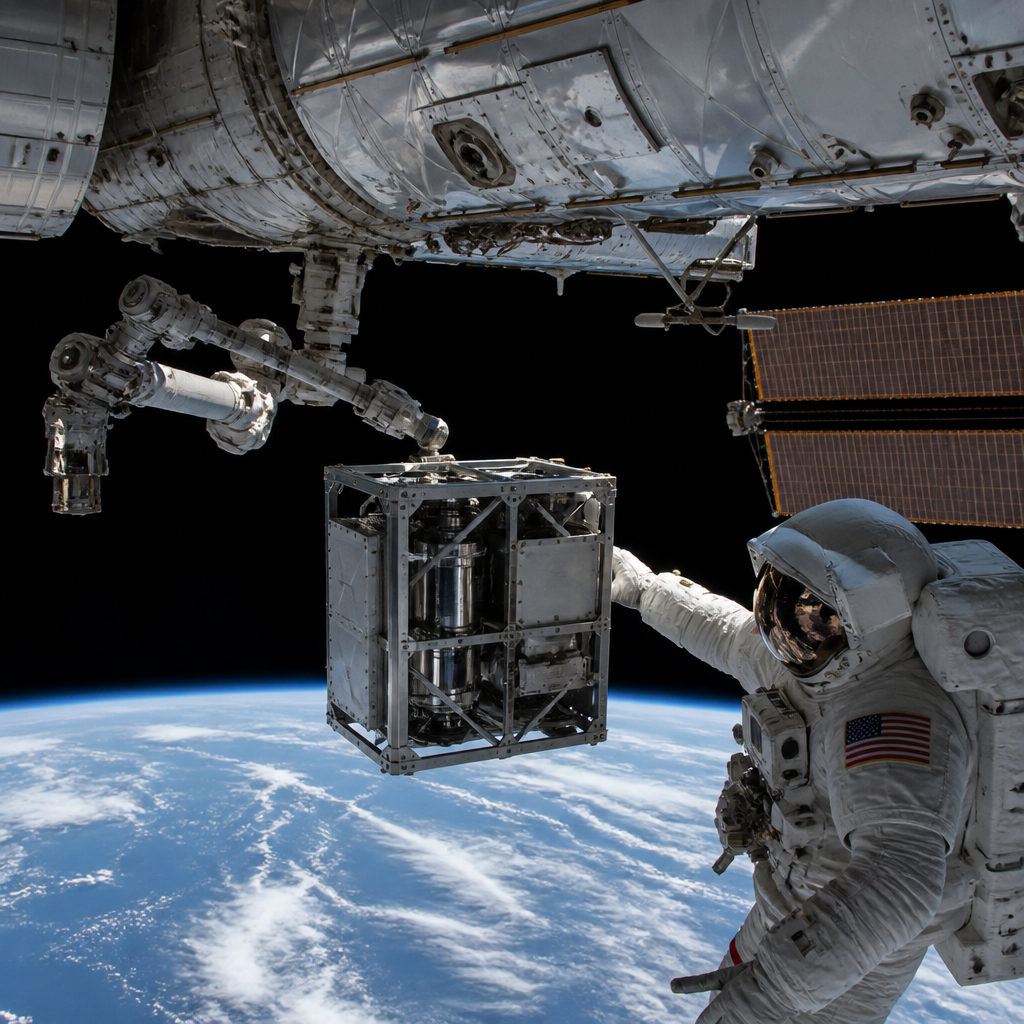
Space manufacturing startups are turning orbital production from science fiction into a commercial category, and the shift matters because microgravity can change how materials form, how medicines crystallize, and how high-value hardware is built. In practical terms, space manufacturing means making products in orbit rather than simply launching finished goods from Earth. The idea includes pharmaceutical research on the International Space Station, semiconductor and optical fiber experiments in low Earth orbit, and future concepts for assembling satellites, solar arrays, and habitats directly in space. I have watched this market move from grant-funded demonstrations to serious venture-backed companies with signed contracts, flight heritage, and customers who care less about spectacle than unit economics. That evolution is why this topic now sits at the center of space and defense technology. Launch costs have fallen, reusable rockets have increased cadence, and commercial stations are being designed to host industrial payloads. At the same time, defense agencies want more resilient supply chains in orbit, while private investors see specialized manufacturing as a path to margins that launch services alone often cannot deliver. For founders, the core question is simple: what products gain enough performance advantage in microgravity to justify the cost and risk of orbital operations?
The answer is no longer hypothetical. Several product classes already show promise because gravity, convection, and contamination affect them differently in space. Protein crystals can grow with fewer defects, potentially improving structure analysis for drug discovery. ZBLAN fiber, a heavy-metal fluoride optical fiber, may achieve lower signal loss when drawn in microgravity than on Earth, where crystallization and sedimentation degrade quality. Semiconductor wafers, advanced alloys, and bioprinted tissues are also under active study. This hub article explains why startups are pursuing those opportunities, where the market is credible today, how orbital factories fit into the broader space and defense tech landscape, and what business models are emerging. It also frames the risks honestly: not every experiment becomes a product, not every payload can scale, and orbital economics remain unforgiving. Still, the direction is clear. Building in orbit is becoming a business because the underlying infrastructure, customer demand, and technical evidence are aligning at the same time.
Why microgravity changes manufacturing economics
Microgravity is valuable because it alters the physical forces that shape materials during production. On Earth, gravity drives buoyancy, sedimentation, and convection, which can introduce defects during crystal growth, melting, solidification, and fluid mixing. In orbit, those effects are reduced, allowing some materials to form with greater uniformity. That does not make every process better in space, but it creates a measurable advantage for select products where performance is worth far more than mass. When I assess a startup in this category, I look first at value density: can a kilogram of product made in orbit command enough price premium to absorb launch, return, insurance, and mission integration costs?
Optical fiber is a good example of this calculation. Companies developing ZBLAN fiber argue that microgravity production can reduce imperfections that raise attenuation, which matters in long-distance communications, medical lasers, and defense sensing. If the finished fiber performs materially better than terrestrial alternatives, customers may pay a premium that supports the mission. Pharmaceutical applications follow a similar logic. Improved crystal quality can help researchers map molecular structures more accurately, which may accelerate formulation work for certain drugs. The value lies less in producing bulk medication in space today and more in generating superior R&D outputs that justify mission expense. This is why early revenue often comes from research services, premium materials, and government contracts rather than high-volume consumer manufacturing.
The startup landscape in space and defense tech
Space manufacturing startups sit inside a larger ecosystem that includes launch providers, satellite operators, in-space logistics firms, station developers, and defense technology contractors. The most credible companies rarely operate alone. They partner with transportation providers such as SpaceX, Rocket Lab, or Sierra Space, book lab time on the ISS or commercial free-flyers, and design payloads to meet strict safety and power constraints. Redwire has flown industrial experiments and orbital manufacturing hardware. Varda Space Industries has drawn attention with its reentry capsule model, aiming to manufacture pharmaceuticals and other high-value products in orbit, then bring them back to Earth. Space Forge, based in the UK, is pursuing reusable returnable satellites focused on advanced materials and semiconductor-related applications.
Defense relevance strengthens the category. Agencies want on-orbit repair, refueling, and eventually production because logistics from Earth are slow, expensive, and vulnerable. The U.S. Space Force and DARPA have both supported technologies tied to space domain awareness, autonomous operations, robotics, and in-space servicing. Manufacturing is a logical extension. If a military satellite can be repaired or upgraded in orbit, or if replacement components can be produced closer to the point of use, resilience improves. That does not mean every startup should chase defense money, but dual-use economics are real. In my experience, companies that can serve both commercial and government buyers have a better chance of surviving the long development cycle that space hardware demands.
Where today’s real commercial opportunities are
The strongest near-term opportunities are not evenly distributed across the market. Some applications have clear customers and testable milestones, while others remain speculative. The practical winners today share three traits: high value per kilogram, a credible technical mechanism for microgravity advantage, and a realistic path to repeated missions. That narrows the field considerably.
| Application | Why orbit helps | Near-term customer | Main constraint |
|---|---|---|---|
| Pharmaceutical crystals | Reduced convection can improve crystal uniformity | Drug developers and research labs | Limited scale and strict validation |
| ZBLAN optical fiber | Lower defect formation during drawing | Telecom, medical, defense optics buyers | Consistent quality at commercial volume |
| Advanced semiconductors | Potentially cleaner crystal growth and materials processing | Specialty electronics and defense programs | Extremely high process control requirements |
| Bioprinting and tissue models | Cells can assemble differently in microgravity | Biotech and medical research firms | Regulatory pathway and reproducibility |
| In-space assembly of structures | Avoids launch fairing size limits | Satellite operators and defense agencies | Robotics complexity and reliability |
Among these, in-space assembly may ultimately become the largest market by revenue, even if materials manufacturing gets more attention today. Very large antennas, solar power systems, fuel depots, and modular spacecraft are constrained by rocket fairings and launch loads. Building or expanding them in orbit changes the design equation. Companies working on robotic assembly, additive manufacturing, and autonomous inspection are therefore part of the same hub topic, even when they are not producing fibers or crystals. For a sub-pillar on space and defense tech, that connection matters: orbital manufacturing is not one niche, but a stack of interdependent capabilities.
The infrastructure making orbital factories possible
Three infrastructure shifts are making this business more plausible than it was a decade ago. First, launch has become more available. Reusability, rideshare programs, and higher annual cadence have reduced the waiting time and relative cost of getting payloads to orbit. Second, return systems are improving. A startup that manufactures in orbit often needs safe, controlled reentry and payload recovery, which is why reentry capsules are strategically important. Third, commercial destinations are emerging beyond the ISS. Companies developing private stations, free-flying labs, and service modules are building the equivalent of industrial parks in orbit, with power, thermal management, communications, and crew or robotic support.
This infrastructure stack also includes digital systems. Modern payloads are designed around autonomy because crew time is scarce and expensive. Edge computing, machine vision, telemetry compression, and digital twins allow experiments to run with minimal intervention. Standards matter here. NASA payload integration rules, mission assurance processes, and export control compliance all shape product design from the beginning. Founders who treat these as late-stage paperwork usually pay for it in delays. The better teams design for launch vibration, vacuum compatibility, fault tolerance, and remote operations from day one. That engineering discipline is not glamorous, but it is the difference between a concept slide and a repeatable business.
Business models, regulation, and the hard realities
Space manufacturing startups generally monetize in four ways: paid research missions, contract development for government or enterprise customers, direct sale of returned products, and platform access fees for other payload developers. The first two are the easiest starting points because they generate revenue before full-scale product-market fit is proven. The third offers the largest upside but also the toughest scrutiny. If you are selling a material, buyers will demand batch consistency, test data, and comparative benchmarks against terrestrial production. If you are selling biomedical outputs, regulatory pathways become central. In the United States, FDA requirements can shape timelines as much as engineering does.
Capital intensity is the defining challenge. These startups need hardware, launch slots, insurance, quality systems, and often years of validation before recurring revenue arrives. That is why non-dilutive funding, strategic partnerships, and milestone-based contracting are so important. National security customers can help, but they also bring procurement complexity and classification limits. There are operational risks as well: launch delays, on-orbit anomalies, reentry failures, and shifting station availability can break carefully planned schedules. Investors should not confuse a successful demonstration with a scalable manufacturing operation. The best companies show a sequence: laboratory evidence, flight validation, repeat missions, customer pull, then manufacturing scale. Skip a step, and the economics usually collapse.
Space manufacturing startups are becoming a real business because three conditions now reinforce each other: physics-based product advantages, maturing orbital infrastructure, and customers willing to pay for performance that Earth-bound production cannot easily match. The most credible opportunities today are premium materials, pharmaceutical research outputs, and in-space assembly for larger spacecraft and defense systems. Success depends on rigorous engineering, realistic mission economics, and careful navigation of regulation, procurement, and supply-chain risk. This is why space and defense tech should be understood as one connected market rather than isolated niches. Launch, robotics, stations, reentry, autonomy, and advanced materials all feed the same industrial future. For founders, the lesson is to target applications where microgravity creates a clear and defensible edge. For investors and operators, the signal to watch is repeatability: can a company fly again, deliver consistent results, and expand from demonstration to dependable production? Follow that metric, and you will quickly separate orbital manufacturing theater from businesses with lasting potential. If you cover or invest in tech innovation, keep space manufacturing on your watchlist now.
Frequently Asked Questions
What is space manufacturing, and how is it different from traditional manufacturing on Earth?
Space manufacturing is the process of making, assembling, or growing products in orbit instead of producing them entirely on Earth. The key difference is the environment. In space, manufacturers can work in microgravity, ultra-clean vacuum conditions, extreme temperature ranges, and radiation environments that are difficult or expensive to reproduce on the ground. Those conditions can change how liquids mix, how crystals form, how metals solidify, and how delicate structures develop. That matters because some products may perform better or be easier to produce when gravity is no longer dominating the process.
Traditional manufacturing on Earth is shaped by gravity at every stage. Materials settle, convection currents form in liquids, and heavier components can separate from lighter ones. In orbit, many of those effects are reduced or behave differently, which opens up the possibility of creating purer crystals, more uniform fibers, or more precise biological structures. In practical terms, space manufacturing is not just about launching a factory into orbit. It includes research and development aboard platforms such as the International Space Station, automated production systems inside free-flying spacecraft, and future orbital facilities designed specifically for commercial output.
Another important distinction is the business model. Traditional manufacturing usually relies on mature supply chains, easy maintenance access, and low-cost transportation. Space manufacturing startups have to design around launch costs, remote operations, limited crew involvement, and safe return of finished products to Earth if those products are intended for terrestrial markets. As a result, the sector tends to focus first on very high-value goods, such as pharmaceuticals, advanced materials, semiconductors, or specialty optical fibers, where the performance gains can justify the expense of producing them in orbit.
Why are startups and investors taking space manufacturing seriously now?
Space manufacturing is attracting real business attention because several barriers that once made it purely speculative are starting to come down at the same time. Launch has become more frequent and, in relative terms, more accessible. Commercial space stations and orbital service platforms are being planned. Robotics, automation, remote sensing, and miniaturized lab equipment have improved significantly. Together, those advances make it more plausible for a startup to test a production process in orbit without needing the budget of a national space agency.
Investors are also paying attention because the category sits at the intersection of multiple high-value industries. Drug development, semiconductors, advanced communications, defense technologies, and specialty materials all stand to benefit if manufacturing in microgravity creates measurable performance advantages. A startup does not have to replace all Earth-based production to become viable. It only has to prove that a narrow class of products can be made better, more reliably, or with higher margins in orbit. That is a much more realistic commercial pathway than the older vision of giant off-world factories appearing all at once.
There is also a broader strategic reason for the growing interest. Space is increasingly viewed as economic infrastructure rather than just a research destination. If satellites support communications, navigation, climate monitoring, and defense, then orbital industrial capability becomes part of a larger long-term ecosystem. Startups entering the field now are positioning themselves early in what could become a foundational market. In that sense, investors are not simply betting on a single experiment aboard the ISS. They are betting on the idea that low Earth orbit may evolve into an industrial zone where making products, testing materials, and assembling high-value hardware become normal commercial activities.
What kinds of products are most promising to manufacture in orbit?
The most promising products are typically those that gain a clear and valuable advantage from the space environment. Pharmaceuticals are one of the leading examples. In microgravity, protein crystals can sometimes grow larger or more uniformly than they do on Earth, which can help researchers better understand molecular structures and potentially improve drug development. Orbital production is also being explored for biological tissues and other biotech applications where gravity may interfere with delicate growth patterns.
Advanced materials are another major category. Specialty optical fibers, certain semiconductor materials, high-performance alloys, and ultra-pure crystals may form differently in microgravity, potentially offering better quality or properties that are difficult to achieve in terrestrial factories. Optical fiber research, for example, has drawn attention because some experimental fibers may have lower signal loss than conventional products made on Earth. If those performance gains are confirmed at scale, even niche applications could support a profitable market because telecommunications, sensing, and defense sectors place a premium on superior materials.
There is also growing interest in making high-value hardware components in orbit, especially parts that benefit from precise layering, reduced structural stress during formation, or in-space assembly. Over time, that could include spacecraft components, large antenna structures, solar power systems, or thermal management hardware built directly where they will be used. In the near term, however, the strongest business cases are likely to remain concentrated in products with high value per kilogram, strong performance sensitivity, and customers willing to pay for measurable improvements rather than novelty alone.
What are the biggest challenges facing space manufacturing startups?
The biggest challenge is proving that manufacturing in orbit creates a durable economic advantage, not just a scientific curiosity. It is one thing to produce an interesting result in a single research mission and another to repeat that result reliably, at commercial quality, over multiple production cycles. Startups need to show that the product made in space is meaningfully better, that customers care about that difference, and that the total cost of launch, operation, and return still leaves room for a viable business.
Operational complexity is another major hurdle. Manufacturing in orbit requires highly automated systems because crew time is limited and expensive. Equipment has to survive launch loads, function remotely, tolerate radiation, and often operate in a confined spacecraft environment with strict power, thermal, and safety constraints. If something fails, technicians cannot simply walk onto a factory floor and replace a part. That makes engineering discipline, redundancy, and mission planning especially important.
There are also infrastructure and timing risks. Today, many experiments and production runs depend on access to the International Space Station or a small number of launch providers and return-capable spacecraft. As the ISS approaches the later stages of its operational life, startups need confidence that commercial stations or alternative orbital platforms will become available on schedule. Regulatory issues, insurance, export controls, and product certification can add another layer of difficulty, especially in industries such as medicine and electronics. In short, the technical promise is real, but the companies that succeed will likely be the ones that solve logistics, scale, customer validation, and infrastructure dependence as effectively as they solve the science.
Could space manufacturing become a major industry, or will it remain a niche market?
In the near term, space manufacturing is likely to remain a specialized market focused on products where microgravity offers a clear and valuable edge. That is normal for a new industrial category. Most breakthrough sectors begin with narrow use cases that justify higher costs before expanding into broader applications. For space manufacturing, those early use cases are likely to involve pharmaceuticals, specialty materials, precision components, and other goods where performance gains can outweigh the cost and complexity of operating in orbit.
Over the longer term, the industry could grow far beyond that niche if orbital infrastructure becomes more robust and less expensive. Reusable launch systems, dedicated commercial space stations, autonomous robotic manufacturing, and better return-to-Earth logistics could all reduce the friction that currently limits scale. At that point, the question shifts from whether one product can be made better in space to whether entire categories of products are best made there. That could eventually include large structures assembled in orbit for satellites, exploration systems, or energy platforms that are impractical to build fully on Earth and launch in one piece.
The strongest case for space manufacturing becoming a major industry is that it aligns with a larger transition in the space economy. As activity in orbit expands, there is growing logic in producing certain goods where they will be used, rather than launching every finished component from Earth. Even so, widespread industrialization in space will not happen overnight. The path is more likely to be incremental: research missions, pilot production, repeatable commercial batches, specialized facilities, and then broader industrial ecosystems. So yes, it has the potential to become a major business sector, but it will probably get there step by step, driven by measurable advantages rather than hype.