Robot safety startups are becoming the missing infrastructure layer that physical AI needs to move from impressive demos to reliable deployment in warehouses, hospitals, farms, sidewalks, and factories. Physical AI refers to software systems that perceive the world, make decisions, and act through machines such as robots, autonomous vehicles, drones, and mobile manipulators. In practice, it combines foundation models, classical controls, computer vision, sensor fusion, motion planning, and embedded hardware. Safety, in this context, means preventing harm to people, property, products, and the environment while maintaining uptime, compliance, and predictable performance. That sounds obvious, but after working with robotics teams, I have seen the same gap repeatedly: companies invest heavily in intelligence and hardware, then discover late that safety engineering is not a feature bolt-on. It is operational infrastructure. Without it, pilots stall, insurers hesitate, regulators intervene, and enterprise buyers delay purchase orders. That is why robot safety startups now matter across the broader Physical AI and Robotics landscape.
For founders, operators, and investors following tech innovations and startups, this topic matters because robotics failures are unusually expensive. A software bug in a consumer app may annoy users; a navigation error in a warehouse robot can injure workers, damage inventory, stop throughput, and trigger legal review. The economics are just as important as the ethics. Safer robots reduce incident rates, simplify risk assessments, shorten enterprise sales cycles, and open markets that would otherwise remain closed. As Physical AI expands, the opportunity is no longer only in building smarter robots. It is also in building the safety stack around them: validation tools, runtime monitoring, formal verification, compliance workflows, human-robot interaction systems, incident analytics, and secure controls. This article explains where robot safety startups fit, why they are indispensable, and which subtopics define the Physical AI & Robotics market today.
Why physical AI needs a safety infrastructure layer
Every robotics company eventually confronts a hard truth: intelligence without bounded behavior is commercially fragile. In controlled demos, systems perform under curated conditions. In production, conditions shift constantly. Pallets overhang, floors reflect light, workers improvise routes, tools wear down, and connectivity drops. A robot that handles ninety-nine scenarios well can still be unacceptable if the hundredth scenario creates unsafe motion. That is why safety infrastructure exists separately from core autonomy. It provides guardrails before deployment, oversight during operation, and evidence after incidents.
In industrial environments, recognized standards already frame the discussion. ISO 10218 covers industrial robot safety, ISO/TS 15066 addresses collaborative robot operation, and IEC 61508 is foundational for functional safety in electrical and programmable systems. Autonomous mobile robots also intersect with ANSI/RIA guidance, machine guarding requirements, and site-specific risk assessments. Startups entering this layer help robotics companies interpret and implement these standards without building every capability in-house. The result is similar to what cybersecurity platforms did for cloud computing: they transformed a critical but fragmented requirement into repeatable tooling.
Real-world examples make the need clear. Amazon warehouses use extensive sensing, geofencing, and operational rules to separate humans and mobile systems. Hospital delivery robots must manage elevators, crowded hallways, and privacy-sensitive environments. Agricultural robots face dust, weather, uneven terrain, and unpredictable interactions with seasonal labor. In each setting, the challenge is not just making the robot act autonomously. The challenge is proving that it can detect hazards, degrade gracefully, request help, and remain auditable. That proof is where safety startups create leverage.
The core categories of robot safety startups
The robot safety startup market is broader than emergency stop buttons and compliance paperwork. The most important categories include simulation-based validation, runtime monitoring, safety-certified control systems, human-robot interaction safeguards, cybersecurity for robotic platforms, and incident intelligence. These categories increasingly overlap because modern robots are software-defined machines with continuously updated behavior.
Simulation and validation companies build digital environments where teams can test edge cases before field deployment. NVIDIA Isaac Sim, Gazebo, and Webots are well-known platforms, while startups add scenario generation, synthetic data, and pass-fail safety metrics. If a warehouse robot must navigate around a fallen box, a stopped forklift, and a person stepping into an aisle, simulation can recreate that situation thousands of times. This does not eliminate field testing, but it radically improves coverage and shortens debugging cycles.
Runtime monitoring startups focus on what happens after deployment. They track perception confidence, actuator anomalies, near misses, geofence violations, and policy exceptions in real time. In my experience, this layer often delivers immediate value because operations teams need visibility before they trust autonomy at scale. A robot that can explain why it slowed down, handed off control, or refused a task is easier to operate and insure than one that simply stops with an opaque error code.
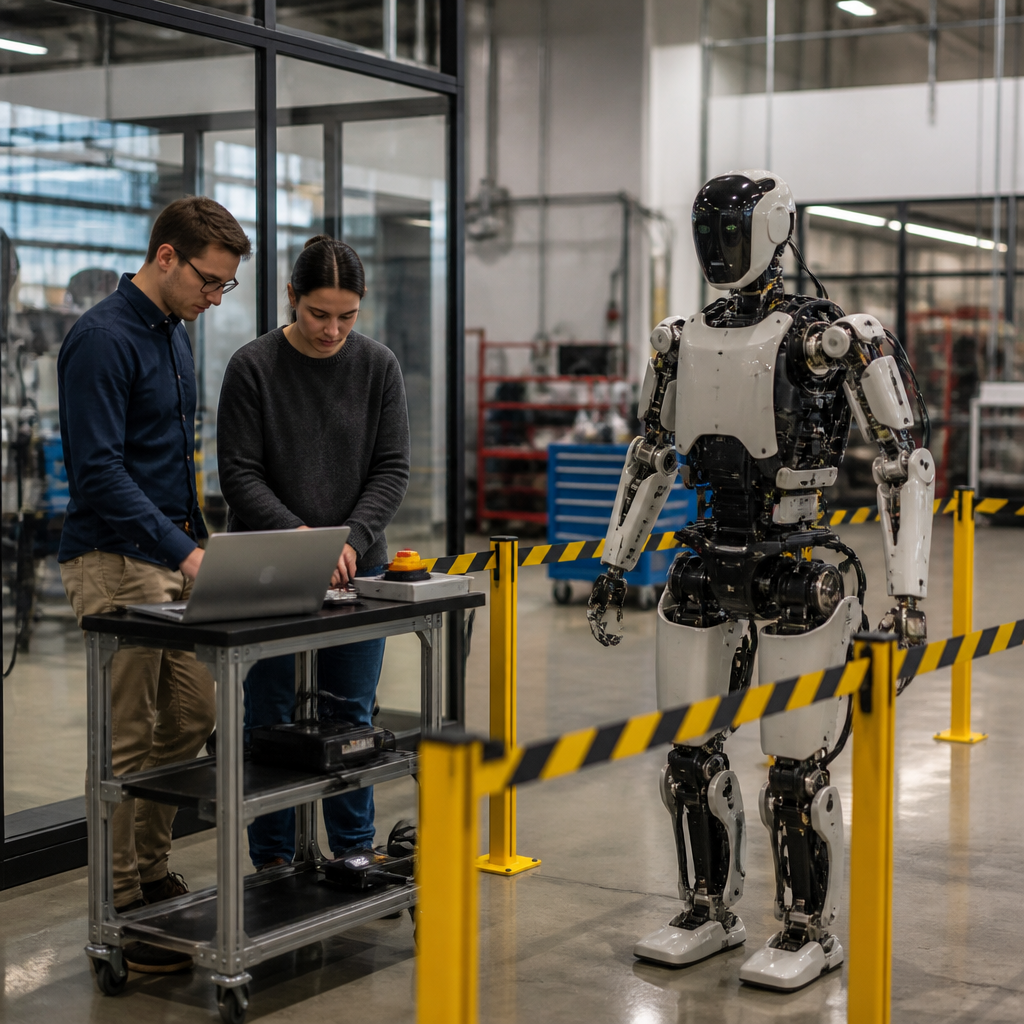
Human-robot interaction safety is another growing segment. Collaborative robots, service robots, and autonomous mobile robots share space with people, so speed-and-separation monitoring, force limiting, intent signaling, and ergonomic workflow design matter. Good startups here understand both machine sensing and human factors. The best systems combine lidar, RGB-D cameras, wearable tags, and site rules to create dynamic safety envelopes rather than static exclusion zones.
Where safety sits in the physical AI technology stack
Physical AI and Robotics is best understood as a stack. At the bottom are hardware components: sensors, compute modules, actuators, batteries, end effectors, and communications. Above that sit middleware and operating frameworks such as ROS 2, real-time Linux, DDS messaging, and fleet management systems. Then come perception models, localization, mapping, planning, controls, and task-specific applications. Safety cuts across every layer rather than occupying only one box. A perception model with poor calibration can create unsafe trajectories; a networking failure can delay stop commands; a bad user interface can cause unsafe overrides by operators.
This cross-stack role is why hub coverage of Physical AI must include adjacent subtopics. Embodied AI models promise more general robot behavior, but they also increase validation complexity because learned policies can be harder to predict than hand-engineered routines. Autonomous mobile robots depend on fleet orchestration, facility mapping, and traffic management. Industrial robotics intersects with machine vision, programmable logic controllers, and functional safety relays. Drones and field robots add remote operations, geospatial constraints, and environmental variability. Even humanoid robotics, despite the headlines, is fundamentally a safety problem because balance, manipulation, and human proximity amplify risk.
For startup evaluation, I use a simple filter: does the product reduce uncertainty at design time, deployment time, or incident time? If the answer is yes in a measurable way, it belongs in the infrastructure conversation. Examples include tools that produce traceable risk assessments, systems that certify safe zones around mobile robots, dashboards that quantify disengagement causes, and controls that place robots into predefined safe states after sensor disagreement.
What enterprise buyers, regulators, and insurers look for
Enterprise buyers do not purchase robot safety on vision alone. They look for evidence. Specifically, they want hazard analyses, failure mode coverage, maintenance procedures, training plans, uptime metrics, and documented conformance with applicable standards. A manufacturing plant may ask for performance level calculations under ISO 13849, lockout-tagout procedures, and proof that safety functions have been validated after software updates. A hospital may focus more on navigation reliability, accessibility, infection-control implications, and escalation paths when robots block corridors or fail to dock.
Insurers and regulators ask related questions, but their lens is risk transfer and public harm. They want to know whether incidents are detectable, reconstructable, and containable. This is where startups with logging, telemetry, and event reconstruction capabilities stand out. Black-box style recording for robots is becoming increasingly valuable, especially when mixed autonomy is involved. If a mobile robot stopped suddenly and caused a collision behind it, investigators need synchronized sensor, control, and operator-action data to determine root cause.
| Stakeholder | Main concern | What safety startups provide |
|---|---|---|
| Enterprise operators | Worker safety and uptime | Risk assessments, dashboards, training workflows |
| Regulators | Compliance and incident prevention | Documentation, validation evidence, audit trails |
| Insurers | Loss frequency and claim severity | Monitoring, event reconstruction, control assurance |
| Robot OEMs | Faster deployment and lower support costs | Simulation, runtime safeguards, remote diagnostics |
The strongest startups understand that safety is not merely technical compliance. It is a buying signal. When vendors can show a disciplined safety case, procurement friction drops. Legal reviews move faster, pilot expansion becomes easier, and cross-site replication becomes practical. That commercial acceleration is why infrastructure companies can capture significant value without manufacturing robots themselves.
Startup opportunities across the Physical AI and Robotics hub
Several opportunity areas are emerging across this sub-pillar hub. First is safety validation for foundation-model-driven robotics. As large models are adapted for manipulation, navigation, and multimodal control, companies need ways to constrain actions, test rare edge cases, and monitor distribution drift. Second is compliance automation. Many robotics companies still manage assessments, test logs, and change records in spreadsheets and PDFs. Startups that turn safety evidence into structured, queryable workflows can save months during audits and enterprise onboarding.
Third is environment intelligence. Facilities themselves are becoming part of the safety system through smart beacons, fixed sensors, digital twins, and access controls. A robot operating in a sensor-rich site can be much safer than one relying only on onboard perception. Fourth is cyber-physical security. Compromised robots are safety hazards, not just IT incidents. Secure boot, signed updates, network segmentation, and anomaly detection now belong in any serious robotics deployment plan.
Fifth is post-incident analytics and continuous improvement. Aviation, automotive, and industrial operations all matured through disciplined incident review. Robotics is following the same path. Near-miss reporting, root-cause taxonomies, and benchmark metrics will become standard. Founders building in this market should avoid broad claims and instead target a painful failure point with measurable outcomes: fewer emergency stops, faster hazard reviews, lower false-positive slowdowns, or shorter site-acceptance timelines.
What comes next for robot safety startups
Robot safety startups are the enabling infrastructure that Physical AI has been missing. They turn robotics from a collection of promising machines into an operationally credible category that buyers can deploy with confidence. The winning companies will not replace robot makers; they will make robot makers deployable, insurable, auditable, and scalable. That distinction matters across every segment in this hub, from industrial automation and warehouse robotics to healthcare robots, drones, agricultural systems, and embodied AI platforms.
The key takeaway is straightforward: as robots become more capable, safety becomes more central, not less. More autonomy creates more edge cases, more software updates, and more demand for traceability. Startups that solve those problems sit at a strategic chokepoint in the market. If you are tracking Tech Innovations & Startups, watch the teams building validation, monitoring, compliance, and cyber-physical safeguards around robots. Explore the broader Physical AI & Robotics coverage through related articles on autonomous systems, industrial robotics, embodied AI, robot software stacks, and human-robot interaction. That is where the next durable infrastructure companies are being built.
Frequently Asked Questions
Why are robot safety startups becoming such an important part of the physical AI stack?
Robot safety startups are emerging as a critical infrastructure layer because physical AI does not succeed on intelligence alone. A robot can have impressive perception, planning, and language capabilities, but if it cannot operate safely and predictably around people, equipment, and changing environments, it will struggle to move beyond pilot programs and demos. That is the core gap these startups are addressing. They focus on the systems, tooling, and validation layers that help autonomous machines behave reliably in the real world, especially when conditions are messy, dynamic, and difficult to fully model in advance.
In practice, physical AI combines foundation models, computer vision, sensor fusion, motion planning, controls, and embedded systems. Each of those layers can fail in subtle ways. A camera may be partially occluded, a sensor may drift, a model may misclassify an object, or a planner may generate behavior that is technically valid but operationally unsafe. Safety-focused startups help detect, constrain, and mitigate these risks. They may build runtime monitoring, policy enforcement, fail-safe architectures, anomaly detection, simulation environments, safety cases, or verification workflows that reduce the chance that a small system error becomes a real-world incident.
What makes this especially important now is that robots are leaving controlled industrial cells and entering semi-structured and unstructured environments such as hospitals, farms, sidewalks, warehouses, and mixed-use factories. In those settings, variability is constant. Humans move unpredictably, lighting changes, floors become obstructed, and workflows evolve. Safety startups provide the connective tissue that lets robotic systems handle those uncertainties with stronger guardrails, better testing, and more transparent evidence of operational readiness.
From a business perspective, safety infrastructure also helps unlock deployment. Customers, regulators, insurers, and internal operations teams want proof that a system is not only capable, but trustworthy. Startups in this category help provide that proof, which can shorten sales cycles, improve compliance readiness, and make scaling more realistic. In that sense, robot safety companies are not just reducing risk; they are enabling commercialization.
What does “physical AI” actually mean, and why does safety matter more here than in software-only AI?
Physical AI refers to AI systems that perceive the world, make decisions, and act through physical machines. That includes robots, autonomous vehicles, drones, mobile manipulators, industrial automation systems, and other embodied platforms. Unlike software-only AI, which may generate text, classify images, or make recommendations in a digital environment, physical AI directly influences motion, force, speed, and interaction with real objects and people. The stakes are therefore much higher, because errors can cause damaged inventory, interrupted operations, regulatory violations, or bodily harm.
The difference is not just that physical AI moves; it is that it operates under real-world uncertainty with tight timing and safety constraints. A language model can be wrong and create confusion. A robot can be wrong and collide with a person, drop a payload, enter a restricted area, or fail to stop in time. That means safety cannot be treated as an afterthought or a single feature bolted onto the product. It has to be designed into the full system, from sensing and control to decision policies, human-machine interfaces, redundancy, and emergency procedures.
Another major distinction is that physical AI must bridge two difficult domains at once: intelligence and execution. It is not enough to interpret an environment accurately. The system also has to translate that understanding into stable, controlled, and context-aware action. For example, recognizing a human worker near a forklift route is only useful if the robot can adapt its path, reduce speed, maintain safe separation, and recover gracefully if conditions change. Safety sits inside that entire chain.
Because of this, physical AI deployments require a broader view of risk than traditional software systems. Teams need to think about edge cases, sensor failures, actuation faults, environmental changes, cybersecurity interactions, degraded modes, and human behavior. Robot safety startups often specialize in exactly this systems-level view, helping companies build mechanisms that make embodied AI more robust, auditable, and operationally acceptable in the environments where it needs to work.
What kinds of problems do robot safety startups typically solve for robotics and autonomous systems companies?
Robot safety startups usually focus on reducing the gap between technical capability and real-world reliability. One common area is perception safety: ensuring that people, obstacles, vehicles, tools, and restricted zones are detected accurately across varying lighting, weather, clutter, and sensor conditions. Another is runtime supervision, where independent monitoring systems check whether the robot’s behavior remains within safe operating bounds and trigger intervention if it does not. This can include speed limits, geofencing, collision prediction, fallback policies, or emergency stop orchestration.
They also solve problems in validation and testing. Many robotics companies can demonstrate strong performance in a controlled environment, but customers need evidence that the system will remain safe across edge cases and operating scenarios. Safety startups may build simulation platforms, scenario generation tools, digital twins, data replay systems, or verification frameworks that stress-test autonomy stacks before deployment. These tools help uncover failure modes earlier and create structured documentation that supports internal review, customer trust, and regulatory conversations.
Another major category is safety engineering workflow support. Robotics teams often need help translating broad safety goals into concrete requirements, hazard analyses, risk assessments, and mitigation strategies. Startups may provide software and services for standards alignment, traceability, incident analysis, and safety-case development. That is especially useful for companies moving into regulated or safety-sensitive sectors such as healthcare, logistics, industrial automation, and agriculture.
Some startups also work on middleware and control-layer protections. These can include fail-operational architectures, sensor redundancy management, watchdog systems, policy gating, motion envelope constraints, and techniques for safe degradation when components fail or uncertainty rises. In simple terms, they make sure the robot does not just perform well when everything goes right, but also behaves responsibly when something goes wrong. That capability is essential for scaling from a successful prototype to a dependable fleet.
How do robot safety startups help speed up deployment instead of slowing innovation down?
There is a common misconception that safety slows robotics down, but in most real deployment settings the opposite is true. Companies that ignore safety early often move fast into demonstrations and then stall when they encounter procurement reviews, insurance concerns, integration issues, customer objections, or repeated field failures. Safety startups help teams build the evidence, controls, and operational discipline needed to move through those bottlenecks more efficiently. Rather than acting as a brake, they often function as an accelerator for deployment readiness.
One reason is that structured safety work reduces uncertainty. If a robotics company can clearly show how it identifies hazards, validates edge cases, monitors live behavior, and handles failures, customers become more comfortable rolling the system out in higher-value environments. Safety tooling also helps engineering teams prioritize fixes and understand where performance claims are strong versus fragile. That leads to fewer surprises late in the deployment cycle.
Another reason is that safety infrastructure improves repeatability. Scaling robots across multiple warehouses, hospital wings, farms, or factory lines requires consistency. A startup that provides standardized testing, operational envelopes, fleet monitoring, or policy enforcement can help turn deployment from a custom one-off effort into a repeatable process. That lowers integration friction and makes broader commercialization more feasible.
Safety startups can also shorten time to trust. In physical AI, trust is not built through branding alone; it is built through demonstrated behavior under real constraints. When companies can show measurable safety performance, explain fallback mechanisms, and provide auditable logs or validation records, they often advance faster with enterprise buyers and ecosystem partners. In that way, strong safety infrastructure does not compete with innovation. It is what allows innovation to survive contact with the real world.
What should investors, operators, and robotics founders look for in a strong robot safety startup?
A strong robot safety startup should solve a specific, high-value problem that sits close to real deployment pain. That means the product should not be positioned as generic “AI safety” in the abstract, but as a concrete solution for embodied systems operating in warehouses, hospitals, farms, sidewalks, factories, or similar environments. The best companies usually have a deep understanding of field conditions, failure modes, and the operational constraints that matter to robotics customers, including latency, compute limits, certification requirements, integration complexity, and human workflow realities.
Technical credibility is essential. Founders and teams should understand not only machine learning, but also controls, sensing, systems engineering, reliability, and safety processes. In physical AI, safety is inherently cross-disciplinary. A startup that can bridge software intelligence with hardware realities is typically better positioned than one that treats safety as purely a model-quality problem. Buyers should look for evidence that the company’s approach works under noisy, real-world conditions and can integrate into existing autonomy stacks without creating excessive overhead.
It is also important to evaluate whether the startup creates usable safety evidence. Can it help customers document hazards, validate scenarios, monitor live systems, and demonstrate compliance readiness? Can it support incident review and continuous improvement after deployment? The companies with lasting value are often the ones that help customers operationalize safety rather than just measure it once. That includes tooling, workflows, reporting, and decision support that fit into engineering and operations teams’ day-to-day practices.
Finally, market fit matters. The most compelling robot safety startups usually align with sectors