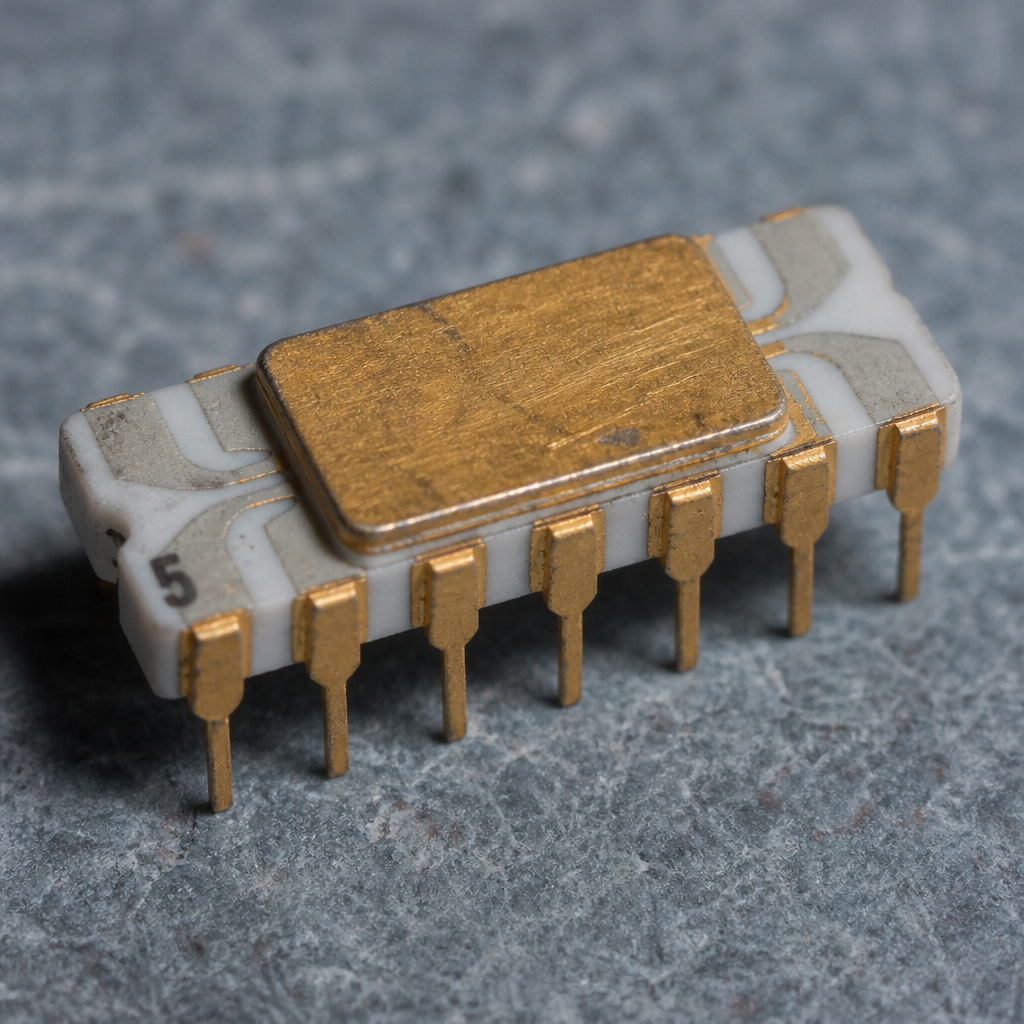
The Intel 4004 marks the moment computing stopped being tied to room-sized machines and started fitting inside products ordinary people could own. Introduced in 1971, the 4004 was the first commercially available single-chip microprocessor, meaning the central processing functions of a computer were integrated onto one piece of silicon instead of spread across many boards and components. For anyone studying semiconductor roots, this device is the hinge point between the transistor age and the embedded world that followed. It did not appear out of nowhere. The Intel 4004 emerged from a dense network of ideas, companies, manufacturing advances, and talent concentrated in Silicon Valley, where semiconductor pioneers had already transformed electronics through planar processing, photolithography, and metal-oxide-semiconductor design.
Understanding why the Intel 4004 matters requires defining a few terms clearly. A semiconductor is a material, usually silicon, whose electrical conductivity can be controlled to build transistors. An integrated circuit places many electronic components onto a single chip. A microprocessor goes a step further by implementing a programmable central processing unit on one chip. The leap was profound because programmability replaced custom logic. Before the 4004, designers often needed different chips or board-level circuits for each product. After the 4004, one standard processor could be paired with memory and software instructions to perform varied tasks. That flexibility changed cost structures, product development timelines, and the economics of innovation.
I keep returning to the 4004 when explaining semiconductor roots because it ties materials science, manufacturing, business strategy, and system architecture into one story. It also explains why Silicon Valley became more than a regional cluster. The same ecosystem that produced Fairchild Semiconductor, Intel, and a generation of process engineers created the conditions for putting a computer on a chip. This hub article traces those roots, from transistor breakthroughs and company spinouts to the Busicom calculator project and the manufacturing discipline needed to make a four-bit processor practical. If you want the shortest answer, it is this: the Intel 4004 succeeded because Silicon Valley had already learned how to turn fragile laboratory inventions into scalable silicon products.
Semiconductor roots: from discrete transistors to integrated circuits
The Intel 4004 belongs to a longer semiconductor timeline that starts with the transistor at Bell Labs in 1947 and gains industrial momentum in California during the late 1950s and 1960s. William Shockley brought transistor research west by founding Shockley Semiconductor Laboratory in Mountain View. Although Shockley’s management style was notoriously difficult, the company became the seedbed for talent. Eight employees left in 1957 to form Fairchild Semiconductor, the famous “Traitorous Eight” episode that directly shaped Silicon Valley’s culture of spinouts and reinvention.
Fairchild mattered because it commercialized manufacturing methods that made complex chips reliable and affordable. Jean Hoerni’s planar process protected transistor surfaces with silicon dioxide, improving durability and allowing more consistent fabrication. Robert Noyce then recognized that the planar process also enabled practical integrated circuits by connecting components with deposited metal interconnects. Those advances solved a real production problem: how to build many transistors together without hand-wiring each one. In parallel, Mohamed Atalla and Dawon Kahng at Bell Labs demonstrated the MOSFET in 1959, providing a transistor structure especially suitable for high-density integration.
By the late 1960s, the semiconductor industry had learned how to place increasing numbers of transistors onto single chips with acceptable yields. This was the manufacturing foundation behind Moore’s Law, Gordon Moore’s 1965 observation that component counts on integrated circuits were rising rapidly while costs per component fell. In practical terms, semiconductor roots are not just about invention; they are about process control. Cleanrooms, mask alignment, wafer handling, diffusion, metallization, and testing all improved together. Without those disciplines, the idea of a microprocessor would have remained a lab curiosity rather than a commercial product families could eventually feel inside calculators, appliances, and personal computers.
Why Silicon Valley was the right place for the 4004
Silicon Valley helped put a computer on a chip because it concentrated the exact capabilities the task required. Engineers with physics training worked alongside process specialists, circuit designers, equipment vendors, and ambitious executives who understood that integrated circuits could move beyond military and aerospace markets into volume commercial products. In my experience reviewing early semiconductor business histories, this concentration matters as much as any one invention. Breakthrough products appear where design knowledge, fabrication capacity, customer demand, and risk capital can interact quickly.
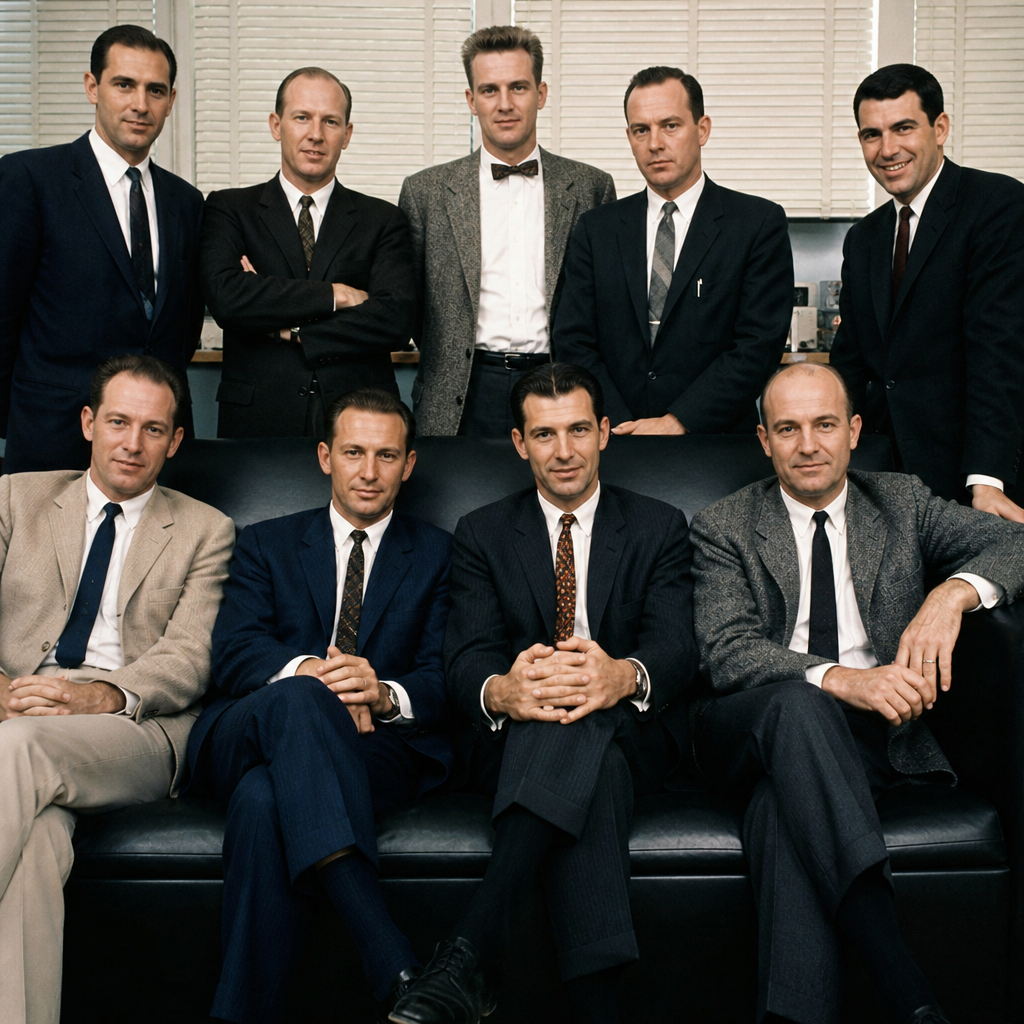
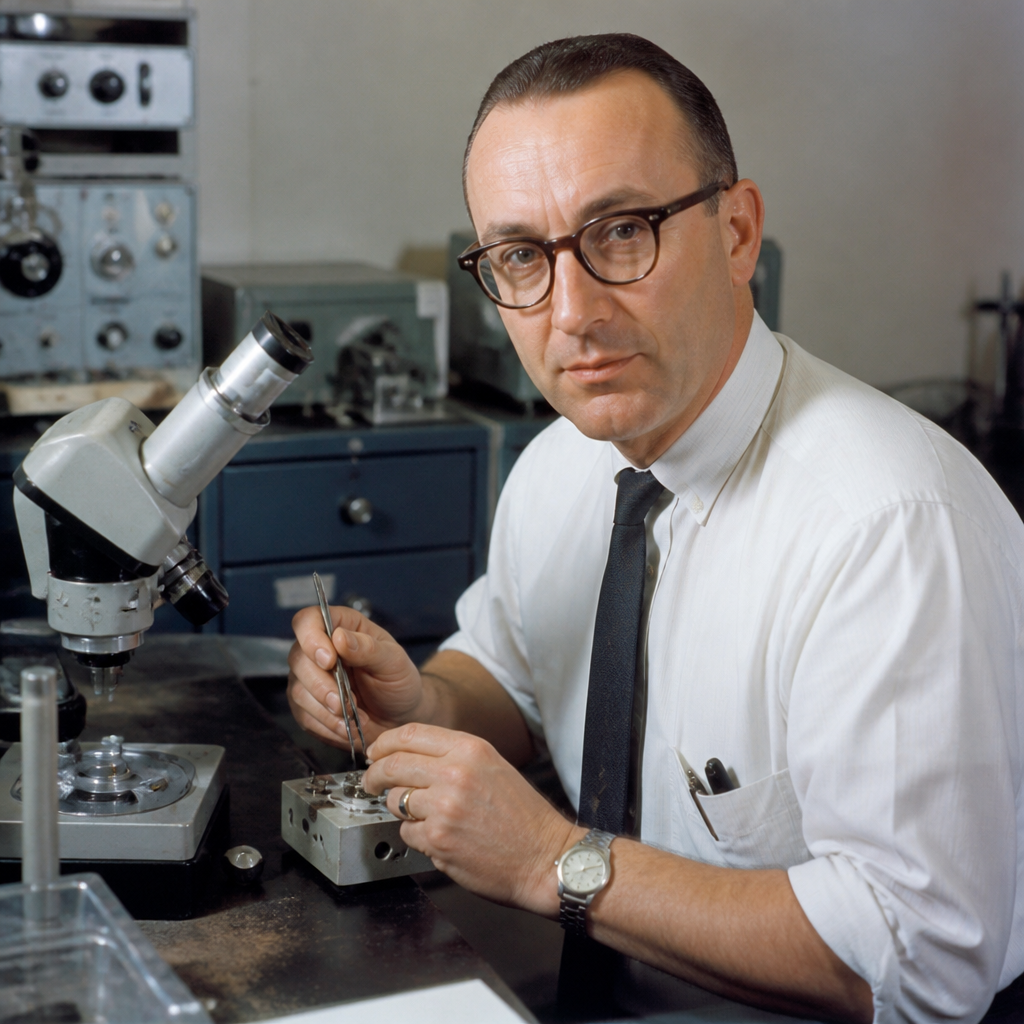
Intel itself was founded in 1968 by Robert Noyce and Gordon Moore, both veterans of Fairchild, with Andrew Grove soon shaping operations. The company initially focused on semiconductor memory, including SRAM and DRAM, because memory was a large and fast-growing market. But Intel’s culture was deeply process-driven. That discipline became critical when a Japanese calculator company, Busicom, approached Intel about custom chips for a new calculator line. Rather than simply building a dozen specialized chips, Intel engineer Ted Hoff proposed a more general architecture: a programmable logic device that could be reused across functions. Federico Faggin, who had worked on silicon gate technology at Fairchild, then led the implementation, with Stanley Mazor contributing architectural work and Masatoshi Shima from Busicom collaborating closely on system requirements.
The result was not an isolated flash of genius. It was a Silicon Valley synthesis. Silicon gate MOS technology allowed higher speed and density than earlier approaches. Intel’s design team reduced a board-level computing system into a four-chip family: the 4004 CPU, the 4001 ROM, the 4002 RAM, and the 4003 shift register. This partitioning made the product manufacturable and usable. Valley companies were already accustomed to solving system problems through chip families rather than single devices, and that mindset helped transform a calculator contract into a general computing platform.
How the Intel 4004 worked and why it was revolutionary
The Intel 4004 was a four-bit CPU containing roughly 2,300 transistors and built using 10-micron silicon gate PMOS technology. It ran at a clock rate up to 740 kHz and executed around 92,000 operations per second under typical conditions. Those numbers seem small today, but historical significance comes from integration, not raw speed. The 4004 placed the arithmetic logic unit, control logic, registers, and instruction handling on one chip. That integration reduced board space, lowered component count, simplified product engineering, and made programmable electronics economically attractive in new categories.
Its instruction set was designed for embedded control tasks such as calculators, where compact code and efficient decimal handling mattered. The processor addressed program memory stored in the 4001 ROM and worked with external RAM rather than integrating everything onto one die, a limitation dictated by transistor budgets and packaging constraints. Even so, the architecture proved a powerful concept: a standardized CPU could be manufactured in volume, then adapted through firmware and support chips to different devices. That was a major shift from fixed-function electronics.
| Feature | Intel 4004 | Why it mattered |
|---|---|---|
| Launch year | 1971 | Established the first commercial single-chip microprocessor market |
| Word size | 4-bit | Well suited to calculator-style decimal operations and control logic |
| Transistor count | About 2,300 | Showed useful CPU complexity could fit on one chip |
| Process technology | 10-micron silicon gate PMOS | Enabled better density and speed than earlier MOS methods |
| Design team | Faggin, Hoff, Mazor, Shima | Illustrated cross-company, cross-disciplinary collaboration |
When I explain the 4004 to modern readers, I compare it to moving from a custom mechanical cash register to a software-defined point-of-sale terminal. The power lies in reuse. A programmable processor turns hardware capability into a platform. This is why the Intel 4004 is not just a calculator chip. It is the commercial proof that general-purpose computing could be packaged as a component.
From Busicom contract to industry turning point
The Busicom story is central to semiconductor roots because it shows how customer constraints can trigger architectural innovation. Busicom wanted a set of chips for calculators, but the original custom approach would have been expensive and complex. Hoff’s proposal reduced the number of custom chips by relying on software control, and Intel negotiated rights that later allowed it to market the processor more broadly. That commercial decision was as important as the technical one. A custom calculator engine became a general product for the wider electronics market.
Intel announced the MCS-4 family in November 1971, positioning it as a “micro-programmable computer on a chip.” Early applications included calculators, test equipment, and embedded controllers. Adoption was not instantaneous. Designers needed tools, documentation, development methods, and confidence in MOS reliability. But the idea had crossed a threshold. Once engineers saw that a CPU could live on a chip, the roadmap opened quickly to the 8008, 8080, and later the 8086, while competitors such as Texas Instruments, Motorola, and Mostek pursued their own paths.
There are limits to the 4004 myth that serious historical writing should acknowledge. It was not the first integrated circuit, not the only early microprocessor concept, and not a machine for general consumer computing in the later personal computer sense. Texas Instruments developed related ideas, and the broader transition depended on memory chips, peripherals, software, and falling system costs. Still, the 4004 deserves its reputation because it made the single-chip CPU commercially concrete. That is the threshold event this Historical Perspectives hub should anchor.
The lasting legacy for semiconductor roots and modern computing
The Intel 4004 matters today because nearly every modern device inherits its core premise: standardized silicon can become many products through architecture, manufacturing scale, and software. Smartphones, automotive controllers, industrial sensors, medical devices, and cloud servers all sit on that continuum. As transistor dimensions shrank from microns to nanometers, chipmakers integrated memory caches, floating-point units, graphics engines, and AI accelerators, but the conceptual leap was already visible in 1971. Put the processor on a chip, manufacture it repeatably, and let programmability multiply its value.
For readers exploring semiconductor roots, the most useful takeaway is that the 4004 was both a technical artifact and an ecosystem outcome. Silicon Valley supplied the materials expertise, process innovations, entrepreneurial mobility, and customer relationships that made microprocessors viable. The transistor led to the integrated circuit; the integrated circuit led to the microprocessor; the microprocessor led to embedded systems and personal computing. Follow that chain and the significance becomes unmistakable. Use this hub as a starting point for deeper articles on Fairchild Semiconductor, MOS technology, Moore’s Law, Busicom, and the evolution from the 4004 to later Intel architectures. The history of modern computing begins when silicon became programmable. Explore those roots, and the present makes far more sense.
Frequently Asked Questions
What made the Intel 4004 such a historic breakthrough in computing?
The Intel 4004 is widely regarded as a turning point because it was the first commercially available single-chip microprocessor. Before it arrived in 1971, the processing logic of a computer was typically spread across multiple circuit boards filled with separate components. That meant computing power was physically large, expensive, and mostly confined to specialized equipment, industrial systems, or room-sized and cabinet-sized machines. The 4004 changed that model by placing the core functions of a central processing unit onto one piece of silicon. In practical terms, it showed that a programmable computer brain could be manufactured as a compact integrated circuit rather than assembled as a bulky collection of parts.
Its importance goes beyond being “first.” The 4004 established the idea that general-purpose computing could be embedded into products people actually used, bought, and interacted with. That shift helped move electronics from fixed-function devices toward programmable systems. Instead of designing a new hardware logic arrangement for every task, engineers could build a product around a microprocessor and define behavior in software or firmware. That was a profound conceptual leap. It laid the groundwork for calculators, terminals, industrial controllers, personal computers, and eventually the vast ecosystem of smart consumer devices that define modern life.
Historically, the 4004 also represents the hinge point between the transistor era and the microprocessor era. Transistors had already transformed electronics by replacing vacuum tubes, but the 4004 demonstrated that integration could go much further: not just smaller components, but an entire CPU on a chip. That made computing more scalable, more manufacturable, and more affordable. In that sense, the Intel 4004 was not merely an engineering milestone; it was the moment computing became something that could leave the computer room and begin entering the wider world.
Why is the Intel 4004 called the first single-chip microprocessor?
The phrase “single-chip microprocessor” matters because it describes exactly what the 4004 achieved. A processor is the part of a computer that performs arithmetic, logic, control, and instruction handling. Before the 4004, those functions were usually implemented across many separate chips or even larger assemblies of electronic components. The 4004 integrated those central processing functions into one silicon chip, making it a true microprocessor in the modern sense. That integration was commercially significant because it simplified design, reduced physical size, lowered system complexity, and opened the door to mass production.
It is also important to emphasize the “commercially available” part of the description. The 4004 was not just a laboratory demonstration or an internal prototype; it was a product that could be sold and incorporated into real devices. That commercial availability is a major reason it occupies such a prominent place in computing history. It proved that a CPU-on-a-chip was not only technically possible but economically viable. Once that threshold had been crossed, the race toward more powerful and more widely used microprocessors accelerated rapidly.
The 4004 itself was a 4-bit processor, which means it handled data in relatively small chunks compared with later 8-bit, 16-bit, 32-bit, and 64-bit designs. By modern standards, it was modest. But historical importance is not measured only by raw performance. The breakthrough was architectural integration. The 4004 condensed computer intelligence into a compact semiconductor package and made programmable control practical for smaller products. That is why historians, engineers, and technology writers continue to identify it as the first commercially available single-chip microprocessor.
How did Silicon Valley help make the Intel 4004 possible?
Silicon Valley’s role in the story of the Intel 4004 was both technical and cultural. Technically, the region had become a dense concentration of semiconductor talent by the late 1960s and early 1970s. Engineers, physicists, and entrepreneurs were working in close proximity, building on knowledge first developed in transistor research and then expanded through integrated circuit manufacturing. Companies in the region pushed rapid iteration in chip design, fabrication techniques, and production methods. Intel itself emerged from this environment, benefiting from the Valley’s unique mix of scientific expertise, venture-backed ambition, and a willingness to turn advanced electronics into scalable commercial products.
Culturally, Silicon Valley encouraged a mindset that favored integration, miniaturization, and practical application. Rather than treating semiconductors as isolated research achievements, Valley firms looked for ways to turn them into adaptable building blocks for entire industries. That is exactly what the 4004 became. The chip was born out of a project that demanded compact programmable logic, and Intel’s engineers responded by creating a more general solution than a custom one-off circuit set. That kind of leap—from solving a narrow product need to inventing a platform technology—is deeply associated with Silicon Valley’s innovation style.
The Intel 4004 also reflects the Valley’s collaborative and fast-moving nature. The region was shaped by spinouts, shared expertise, and competition among people who often knew one another professionally. Ideas about semiconductor fabrication, chip design, and system architecture moved quickly in that environment. The result was not just one successful chip, but the beginning of an industry pattern: increasingly powerful integrated processors enabling entirely new markets. In that sense, Silicon Valley did not merely host the invention of the 4004; it provided the ecosystem that made such a device thinkable, buildable, and commercially transformative.
How did the Intel 4004 change the kinds of products that could include computing power?
Before microprocessors like the Intel 4004, adding computing capability to a product often required substantial hardware made from many components, which raised cost, increased size, and limited flexibility. The 4004 changed that equation by offering a programmable processing unit in a far smaller package. This meant manufacturers could begin considering embedded intelligence in products that would never have justified a traditional computer design. Instead of building dedicated hardwired logic for every function, designers could create systems that were more adaptable and easier to update through changes in code or control logic.
This mattered enormously for the evolution of consumer and industrial electronics. Compact programmable chips made it feasible to build smarter calculators, control systems, terminals, instruments, and specialized business machines. Over time, that same design philosophy expanded into appliances, automobiles, communications equipment, medical devices, and eventually personal computers. The 4004 itself was only an early step, but it proved the model: computing could be tucked inside a product rather than existing as a standalone machine. That was a foundational change in how engineers thought about electronics.
The broader consequence was that computing stopped being something people accessed only in centralized locations and started becoming something embedded in everyday tools. That shift is easy to overlook now because embedded processors are everywhere, but the 4004 sits near the beginning of that story. It helped establish the notion that products could be intelligent, responsive, and programmable without being physically large computers. In that way, the 4004 did not just shrink existing computing; it expanded where computing could exist at all.
Why does the Intel 4004 still matter today if modern chips are so much more powerful?
The Intel 4004 still matters because historical significance is not erased by later improvement. Modern processors are vastly faster, denser, and more capable, but they follow a path that the 4004 helped define. The key legacy of the 4004 is not its speed or word size by today’s standards; it is the successful demonstration that a central processor could be integrated onto a single chip and sold as a practical commercial component. That idea became the foundation of the entire microprocessor industry. Every smartphone processor, laptop CPU, server chip, and embedded controller exists in a lineage shaped by that original breakthrough.
It also matters as a case study in how technology transitions happen. The 4004 arrived at the moment when semiconductor manufacturing, integrated circuit design, and market demand converged. It shows that major innovations are often not isolated inventions but inflection points where prior advances become usable in a new form. For students of computing history, the chip represents the bridge between the age of discrete electronic systems and the age of compact, programmable silicon platforms. Understanding the 4004 helps explain why computing became personal, portable, and pervasive.
There is also enduring symbolic value in the 4004. It marks the moment the computer stopped being primarily a machine you visited and started becoming a capability you could embed almost anywhere. That conceptual shift underlies modern digital life. When people talk about smart devices, connected products, edge computing, and the intelligence built into ordinary objects, they are talking about a world made possible by the microprocessor revolution. The Intel 4004 stands at the head of that revolution, which is why it remains one of the most important chips ever introduced.