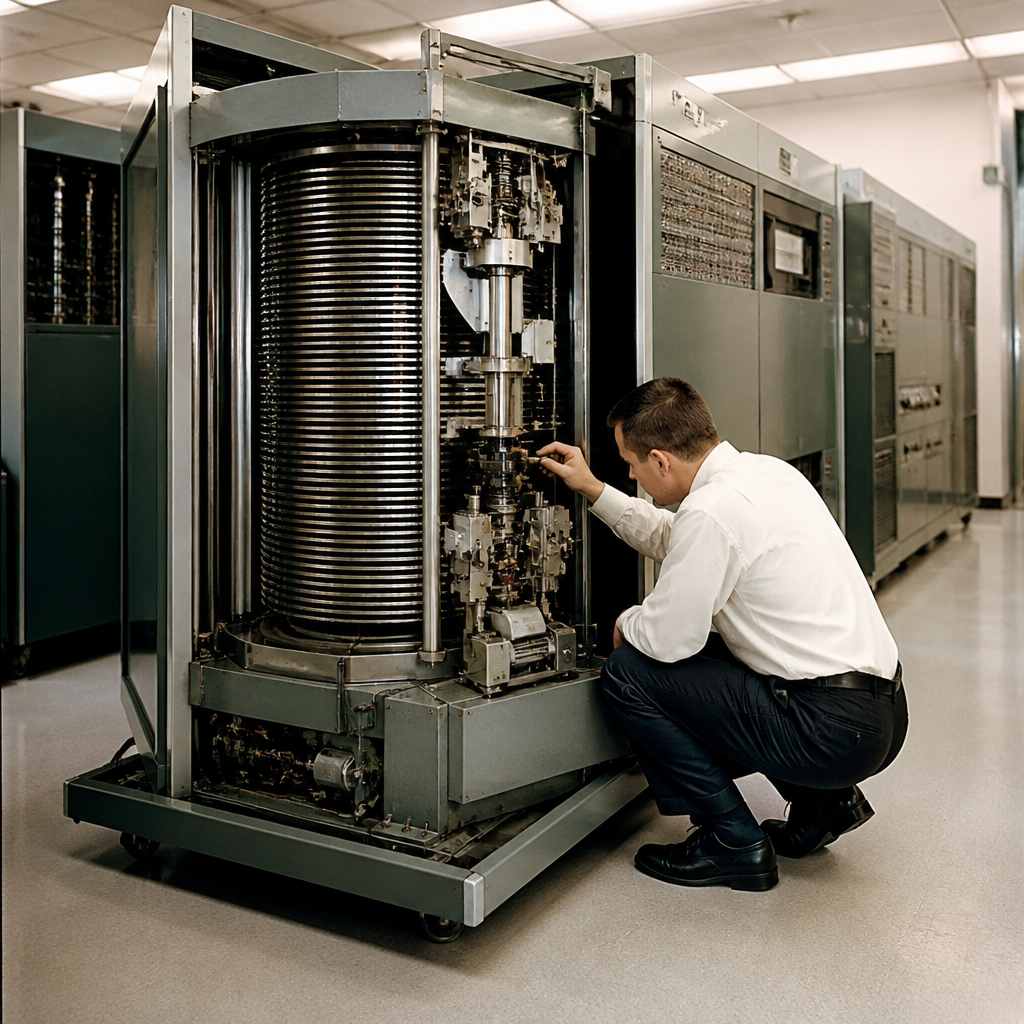

The Winchester drive reshaped modern computing by making hard disk storage smaller, cheaper, cleaner, and practical enough for the systems that would define the next fifty years. In the history of computing, storage breakthroughs often matter more than processor milestones, because information only becomes economically useful when it can be saved, retrieved, and moved at scale. “Winchester drive” refers to IBM’s sealed hard disk technology introduced in the early 1970s, most famously in the IBM 3340, a design developed at IBM’s San Jose laboratory. Its importance was not merely technical. It changed the economics of data storage by reducing cost per megabyte, improving reliability, simplifying maintenance, and enabling disk storage to move from carefully managed enterprise environments into minicomputers, personal computers, office systems, and eventually the consumer internet ecosystem. As a hub within Computing, Storage & Internet history, this topic connects directly to magnetic recording, data center architecture, database growth, backup practice, networking, and the web itself. To understand why today’s cloud infrastructure exists, you have to understand why Winchester made random-access storage a routine expectation rather than an exceptional expense.
Before Winchester, disk drives were large electromechanical systems with removable packs, exposed media handling, and significant service overhead. In practical terms, operators had to mount disk packs, protect them from contamination, and tolerate more frequent alignment and maintenance issues. Storage was precious, centralized, and often rationed. Application designers wrote around scarcity: smaller files, stricter retention rules, batch processing, and heavy dependence on tape for anything not needed immediately. I have worked with archives that still preserve these operational assumptions in file structures and backup policies. The Winchester concept replaced much of that fragility with a sealed head-and-disk assembly, tighter flying-head control, and a lower-risk operating model. That shift mattered because economics in storage are never just about purchase price. They include floor space, downtime, staffing, error rates, throughput, and how confidently an organization can build new software on top of persistent data. Once disk became more dependable and more modular, entire categories of systems became financially reasonable.
What IBM San Jose Actually Built
IBM San Jose, later closely associated with major storage research and eventually the Almaden lineage, was the center of IBM’s disk innovation culture. The IBM 3340 Winchester drive, announced in 1973, is widely cited as the landmark product. It used a sealed mechanism that sharply reduced contamination risk compared with earlier removable disk-pack designs. The “Winchester” name is often explained as an internal nickname tied to an early configuration goal of two 30-megabyte spindles, echoing the .30-30 Winchester rifle designation, though the nickname outlived that exact specification. What matters historically is the architecture: low-mass heads, improved air-bearing behavior, close head-to-media spacing, and an integrated assembly that could be shipped and installed with less field complexity.
This was not the first hard drive; IBM had introduced the RAMAC 305 in 1956. Nor did Winchester instantly replace all storage formats. But it marked the moment when hard disk design became scalable in a way that manufacturing, system integration, and software planning could all exploit. Sealed drives could be produced with tighter tolerances and maintained with fewer operator interventions. The practical effect was that disk stopped being a delicate, highly ceremonial resource and became a standard component around which product lines could be designed. That design logic spread well beyond IBM. Later drives from other vendors inherited the central premise: keep the media environment controlled, shrink the form factor, raise areal density, and let firmware and mechanics deliver predictable random access.
Why Winchester Changed Storage Economics
The economic impact of Winchester came from a compound improvement across several variables at once. Cost per megabyte declined, but equally important, cost per useful stored transaction declined. Reliability improved because sealed assemblies reduced dust-related failures and handling mistakes. Service costs fell because there were fewer opportunities for users to damage media during mounting and removal. Utilization increased because organizations were willing to keep more data online rather than offloading it to slower sequential tape. When more information stays on disk, applications become more interactive, reports can be rerun quickly, and databases can support broader business processes.
Economists of technology sometimes call this a general-purpose infrastructure effect. A component becomes cheaper and more reliable, and then adjacent industries reorganize around the assumption that it will be there. That is exactly what happened with hard disks. Banking systems could hold larger account histories online. Airline reservation platforms could support more concurrent queries. Manufacturers could retain more inventory and production data for planning. Universities and research centers could keep larger datasets directly accessible. In each case, storage economics influenced software design. If random-access storage is scarce and expensive, developers optimize for compression and delay. If it is affordable and dependable, developers optimize for availability, indexing, and user responsiveness.
| Era | Typical Storage Model | Operational Constraint | Economic Result |
|---|---|---|---|
| Pre-sealed disk systems | Removable packs plus tape | Contamination risk, manual handling, higher service burden | Limited online data and cautious application design |
| Winchester generation | Sealed hard disk assemblies | Lower maintenance and better reliability | More data kept online, lower cost per useful workload |
| PC and client-server era | Standardized internal hard drives | Need for mass manufacturing and interface consistency | Storage became a default feature of business and personal systems |
| Internet and cloud era | Disk arrays, then hybrid flash-disk tiers | Scale, redundancy, power, and latency management | Persistent data became the foundation of digital services |
From Mainframes to Minicomputers, PCs, and the Internet
Winchester technology mattered because its descendants escaped the glass house. In the 1970s and 1980s, smaller and more reliable hard drives supported minicomputers from companies such as DEC and Data General, then business systems from Wang and others, and later the personal computer revolution. By the time the IBM PC XT shipped in 1983 with a 10 MB hard disk, the expectation that a smaller system could have fixed magnetic storage was no longer exotic. That expectation transformed office work. Spreadsheets, word processing, local databases, and software development all benefited from persistent random-access storage that did not require enterprise operating procedures.
The internet era depended on that normalization. Email servers, bulletin board systems, Usenet spools, web servers, and search indexes all required economical online storage. Search engines especially are a storage story as much as a compute story. Crawling, indexing, caching, and log analysis become viable only when persistent storage is cheap enough to scale with demand. The same pattern later appeared in cloud computing. Services from Amazon Web Services, Google, and Microsoft could not have emerged without decades of declining disk cost and increasing density rooted in the engineering trajectory Winchester accelerated. Even when flash storage took over latency-sensitive workloads, hard disks remained dominant for bulk storage because the economic model of low-cost capacity still mattered.
Technical Legacy: Areal Density, Interfaces, and Data Management
The Winchester drive’s deeper legacy is architectural discipline. Once sealed disk assemblies became standard, the industry could pursue aggressive gains in areal density, servo control, head design, and manufacturing precision. Later advances including thin-film heads, giant magnetoresistance heads, PRML signal processing, and sophisticated error correction all built on the assumption of a tightly controlled head-disk environment. Standards bodies and vendors also benefited. Interfaces evolved from proprietary channel connections toward ST506, ESDI, SCSI, IDE/ATA, Serial ATA, and SAS, making storage easier to integrate across system classes.
Software changed in parallel. Database systems such as IBM IMS, Oracle, Ingres, and later Microsoft SQL Server and MySQL assumed that direct-access storage would be available in meaningful quantities. Filesystems evolved to manage larger volumes, better caching, journaling, and faster recovery. Backup strategy shifted too. Tape never disappeared, but disk increasingly held active datasets, snapshots, and staging copies. In practice, that meant organizations could ask new questions of their own information. Historical analysis, transaction auditing, and user-facing retrieval all improve when data stays online longer. Storage economics therefore influenced not only machine design but managerial decision-making and the shape of digital business.
Limits, Tradeoffs, and Why the Story Still Matters
Winchester was not a perfect endpoint. Hard drives remained mechanical devices subject to failure, vibration, heat, and eventually limits in magnetic scaling. Sealed units improved reliability, but they also shifted more responsibility to factory precision and firmware quality. Capacity growth created new risks: larger failure domains, longer rebuild times in RAID arrays, and greater consequences when administrators neglected backup verification. Solid-state drives now outperform spinning disks for latency and many transactional workloads. Even so, the historical importance of Winchester remains intact because it established the commercial template for affordable persistent storage at scale.
The broader lesson for Computing, Storage & Internet history is that infrastructure revolutions usually arrive through operational simplification. IBM San Jose did not just make disks better in the lab. It changed what businesses, institutions, and eventually households could justify storing online. That decision cascaded into software design, network services, digital publishing, and cloud platforms. If you are exploring the wider historical landscape, use Winchester as the hinge point linking early mainframe storage, the personal computer boom, enterprise databases, and internet-scale services. Follow that chain, and the economics of data storage become the economics of modern society itself. Continue through the rest of this Historical Perspectives hub to see how storage advances shaped every layer of computing history.
Frequently Asked Questions
What was the Winchester drive, and why was it such an important breakthrough in data storage?
The Winchester drive was IBM’s sealed hard disk technology developed at IBM’s San Jose operation in the early 1970s, and it marked a major turning point in how digital storage was designed, manufactured, and deployed. Earlier disk systems could be large, delicate, and expensive to maintain, often requiring more controlled environments and more hands-on service. The Winchester approach helped change that by enclosing the disk mechanism in a cleaner, more self-contained unit with low-flying read/write heads and removable or compact disk assemblies, depending on the model. That combination dramatically improved reliability, reduced contamination risks, and made hard disk storage practical in a much wider range of computing environments.
Its importance goes well beyond the engineering novelty. The Winchester concept helped shift storage from being a specialized, high-cost infrastructure component into something that could be standardized, scaled, and integrated into mainstream computing systems. That mattered because computing only becomes truly useful at commercial scale when data can be stored economically and accessed consistently. By making hard drives smaller, cleaner, and more dependable, IBM helped set the stage for minicomputers, business systems, workstations, and eventually personal computers to rely on direct-access magnetic storage as a normal part of system design rather than a premium exception.
Why did the Winchester drive change the economics of data storage so dramatically?
The Winchester drive changed storage economics because it lowered the total cost of owning and using disk storage, not just the purchase price of the hardware itself. In computing, economics are shaped by many factors at once: physical size, manufacturing complexity, reliability, maintenance needs, storage density, and how easily a component can be integrated into complete systems. The Winchester design improved several of those variables simultaneously. A more sealed and compact architecture reduced failures caused by dust and handling, while improvements in head and media design enabled higher areal density. That meant more data could be stored in less physical space, with fewer service interruptions and better operational consistency.
Just as important, the technology supported a broader market. When storage becomes smaller and more reliable, system builders can include it in machines aimed at more customers and more use cases. That creates volume, and volume drives manufacturing efficiencies, supplier ecosystems, and standardization. In practical terms, the Winchester drive helped move disk storage toward a model where organizations could justify keeping more information online rather than relying as heavily on slower or more manual storage methods. That shift reduced the cost of access to data, which often matters even more than the cost per device. Businesses could retrieve records faster, update files more easily, and build applications around routine random access to information. In that sense, the Winchester drive did not just make disks cheaper; it made data itself more economically useful.
How did IBM San Jose influence the development of modern hard drives?
IBM San Jose played a foundational role in the history of disk storage because it was one of the central laboratories where hard disk technology evolved from a specialized mainframe component into a broadly influential platform technology. The site had already been crucial in earlier disk drive innovation, and with the Winchester program it helped define the design logic that would shape later generations of hard drives across the industry. Engineers there worked on the interrelated problems that make disk storage viable at scale: head flying height, media precision, contamination control, actuator performance, enclosure design, and manufacturability. Those are not isolated details; together they determine whether a drive can be built reliably, used economically, and improved generation after generation.
The influence of IBM San Jose also came from establishing a model for how storage innovation reaches the market. It was not enough to invent a better disk mechanism in the lab. The breakthrough had to be reproducible, supportable, and suitable for integration into real systems sold to real customers. IBM’s work helped create that bridge between research and commercial productization. Many of the assumptions that later defined the hard drive industry—sealed enclosures, tighter tolerances, higher densities, and modular storage units—owe a great deal to that period of development. Even as the storage market diversified and many other firms entered the field, the engineering and economic direction set by IBM San Jose remained highly influential.
What made Winchester drives different from earlier hard disk systems?
The key difference was that Winchester drives were designed to be cleaner, more compact, and more self-contained than many earlier hard disk systems. Earlier drives often involved larger mechanisms, less protected internal environments, and greater sensitivity to contamination and handling. The Winchester design emphasized a sealed assembly that protected the disks and heads from external dust and airborne particles, which is critical because read/write heads operate extremely close to the disk surface. Even tiny contaminants can cause errors or physical damage. By controlling the internal environment more effectively, Winchester technology made drives more dependable and easier to deploy outside highly specialized settings.
Another major difference was the balance it struck between performance, capacity, and practicality. The design supported higher storage density and more efficient packaging, allowing disk systems to occupy less space while still serving serious computing workloads. It also contributed to a more modular view of storage: a hard disk could increasingly be treated as a manageable subsystem rather than an oversized, fragile installation. That difference seems obvious today, but it was transformative at the time. It changed expectations about where disk storage could be used, who could afford it, and how central it could become to everyday computing. In effect, Winchester drives helped normalize the idea that direct-access storage should be dependable, compact, and commercially routine.
How did the Winchester drive help shape the next fifty years of computing?
The Winchester drive helped shape the next fifty years of computing by making persistent storage practical enough to become a default assumption in system design. Once disk storage became smaller, cheaper, and more reliable, software developers and hardware makers could build around the expectation that users would keep growing amounts of data online and instantly accessible. That expectation influenced everything from business databases and transaction systems to office productivity tools, engineering applications, operating systems, and eventually consumer computing. The real legacy of the Winchester drive is that it helped turn storage from a bottleneck into an enabler.
Its long-term impact also extends to the broader economics of the information age. Modern computing depends on the idea that data can be retained at scale, searched quickly, updated frequently, and moved between systems without prohibitive cost. The Winchester model advanced that reality by reducing the friction around magnetic disk storage and encouraging an industry-wide push toward higher capacity and lower cost per stored bit. Even though later technologies such as solid-state storage introduced new performance and durability advantages, they emerged in a world already shaped by the storage expectations Winchester helped establish. In that sense, the innovation from IBM San Jose was not just a successful product development; it was a structural change in how the computing industry valued, handled, and monetized information.